If you’re shopping for motors to power an RC boat, you want options that balance speed, efficiency, durability, and heat management. This guide highlights five top motors that suit common boat sizes from small DIY kits to mid‑sized racers. Each option targets a different need: beginner-friendly reliability, higher torque for sharp turns, or advanced cooling for long sessions. The buyer’s intent ranges from assembling a hobby project to upgrading for competition-friendly performance.
Summary of selected products
| Product | Best For | Why Selected |
|---|---|---|
| COKOLATIA 2.4G 4-Channel RC Boat Model Kit | Starter DIY projects | All-in-one kit with four-channel remote and 180 motors kit; great for schools or hobbyists building from scratch. |
| LICHIFIT Double 130 Motors RC Boat Drive Set | Small boats, DIY kits | Compact dual motors set with shaft and props; ideal for DIY builds under 30 cm length. |
| Dilwe RC Brushless Motor | General upgrades | High performance upgrade with stable operation; suitable for enthusiasts upgrading existing boats. |
| Surpass Hobby 4082 Brushless Motor | Mid‑size racers | High torque with cooling set; designed for 650–800 mm boats and fast acceleration. |
| Surpass Hobby 3660 Brushless Motor | Balanced performance | Efficient, well-ventilated design for consistent power in mid‑size boats. |
COKOLATIA 2.4G 4-Channel RC Boat Model Kit

- 4-channel remote control with a 180 motor kit; includes remote control, receiver board, and screws
- Remote operation: forward, backward, left, right with 36 mm oars
- Power supply: 6V to receiver, 3V to remote; remote range 50–100 meters
Who this is best for: Beginners and schools needing a complete, ready-to-build RC boat system. This kit supports learning through assembly and basic control. Caution: Not suitable for airplane projects. The kit’s emphasis on propulsion with a straightforward control layout makes it a solid first build.
LICHIFIT Double 130 Motors RC Boat Drive Set

- Two 130 motors with motor seats, copper coupling, 15 cm shaft, and propeller kit
- Suitable for RC boats under 30 cm in length; supports DIY model ships
- Can enable turning without a rudder; provides compact, straightforward propulsion
Best for: Builders working on small, nimble boats where dual motors provide balanced thrust. Limitations: Fits boats under 30 cm; larger hulls may require different motor sizing.
Dilwe RC Brushless Motor (High Performance)
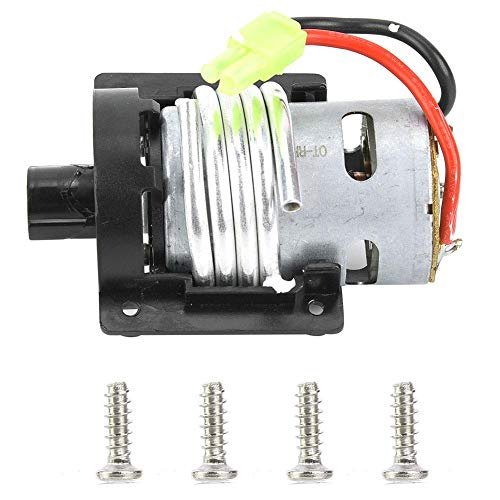
- High performance upgrade motor for better control and fun
- Constructed with quality materials for durability
- Reinforces motor stability during operation
Best for: Enthusiasts upgrading an existing boat to improve speed and handling. Caution: Specific compatibility needs with boat electronics and mounting hardware should be checked before purchase.
Surpass Hobby 4082 Brushless Motor

- Brushless motor designed for 650–800 mm boats; provides strong acceleration
- 4-pole design for high torque and efficiency
- Cooling set and durable construction for long life
Best for: Mid‑size racers needing strong acceleration and reliable cooling. Better for users seeking a balance between power and heat management. Limitation: Requires compatible cooling and mounting setup aligned with hull design.
Surpass Hobby 3660 Brushless Motor

- 3660 brushless motor designed for 650–800 mm boats
- 4-pole design with high torque and efficient power
- Cooling set supports good heat dissipation and longer motor life
Best for: Builders seeking a reliable, well-ventilated motor for consistent performance. Choose this if you want a solid mid‑range option that cools well under extended use.
Surpass Hobby 1250KV Brushless Motor

- 1250KV brushless motor designed for 650–800 mm boats
- 4-pole design for torque and efficient power
- Cooling jacket set to help manage heat during long runs
Best for: Building a capable mid‑size racer with strong acceleration and stable power. Limitation: High KV indicates higher RPM—requires appropriate propeller sizes and ESC settings.
Spektrum 3660 2400Kv Brushless Marine Motor

- Designed for maximum power within NAMBA racing rules
- Water-cooled for lower operating temperatures
- 59.8 mm length for increased torque
Best for: Racers pursuing regulation-compliant power with robust cooling. Avoid this if your boat’s hull or ESC are not compatible with a 2400 KV rating, as higher RPM requires careful prop selection.
Buying Guide: How to Choose the Right RC Boat Motor
- Boat size and hull compatibility: Motors come in ranges that fit specific boat lengths. Match motor size and shaft length to your hull to avoid clearance issues and ensure efficient thrust.
- KV rating and propeller pairing: Higher KV means more RPM; pair with appropriately sized props to maximize speed without overheating. For beginner builds, start with mid-range KV motors and standard props.
- Cooling and heat management: Water-cooling jackets, strong heatsinks, and aluminum components help maintain performance during longer sessions or races. Choose motors with cooling features for hot or high‑duty runs.
- Mounting and hardware compatibility: Ensure your motor mount, shaft, and propeller kit align with the motor’s shaft size and mounting pattern. Some kits include all required hardware; others require separate purchases.
- Reliability and maintenance: Look for robust housings, corrosion-resistant materials, and components designed for repetitive water exposure. Regular inspection of seals, shafts, and connectors extends motor life.
FAQ
- What motor size should I use for a small RC boat?
Choose motors designed for boats under 30 cm or 600–800 mm hulls with compact shafts and propellers to fit size and weight constraints. - Is water cooling necessary for RC boat motors?
Water cooling helps maintain performance during longer runs and high load, reducing overheating, especially in higher KV motors. - How do I choose between brushed and brushless motors?
Brushless motors offer higher efficiency, power, and longevity, but may require more sophisticated electronics and wiring; brushed motors are simpler and cheaper for beginners. - What should I consider when upgrading an existing boat motor?
Ensure the new motor’s KV rating, shaft size, and mounting pattern are compatible with your hull, ESC, and propeller choices to avoid throttling or clearance issues. - Can I mix motors in a dual-motor setup?
If using two motors, they should be matched in KV, torque, and RPM characteristics to maintain balanced thrust and steering.