Whether you’re a weekend boater or a professional crew, accurate fuel gauging is essential. This guide highlights five reliable marine fuel gauge options that fit a range of tanks, senders, and voltages. The best picks cater to boaters needing easy installation, clear readings, and durable construction for saltwater environments. Each product is evaluated for who it’s best for and why it’s a strong choice in different setups.
Product Comparison Snapshot
| Product | Best For | Notes |
|---|---|---|
| 100TECH Boat Fuel Gauge | General marine use, 9–32V systems | Adjustable 240-33Ω to 0-190Ω ranges; clear 8-level scale |
| Sucicago Marine Fuel Gauge | Budget-friendly replacement | Wide compatibility with 0–190Ω, 240–33Ω ranges |
| ARTILAURA Fuel Sending Unit & Gauge Kit | Complete sender + gauge kit | Stainless steel, IP67, 12–24V |
| RUPSE Fuel Sender Unit (6.8″) | Longer tanks, durable stainless steel | 8-color backlight; SAE 5-hole |
| Rupse Fuel Sender Unit (6″) | Mid-size tanks, robust build | Stainless steel, corrosion resistant |
100TECH Boat Fuel Gauge Marine Fuel Gauge

This gauge uses a precision needle with anti-vibration technology to deliver stable readings, even in rough seas. Its 8-level fine scale improves accuracy and helps identify fuel levels clearly. It supports multiple signaling standards (240-33Ω, 0-190Ω, 240-30Ω, 0-180Ω, 10-180Ω) and fits 52 mm (2-1/16″) installations. Best for boaters who want a versatile, easy-to-calibrate gauge for 12V–24V systems. A potential limitation is that complex electrical wiring may require careful calibration to match the sender.
Sucicago Marine Fuel Gauge Aftermarket Gauge

The Sucicago gauge is designed as a direct replacement with smooth needle sweep and broad compatibility across 0–190Ω, 240–33Ω, 240–30Ω, 0–180Ω, and 10–180Ω inputs. It fits 52 mm diameter openings and works in 9–32V DC systems, making it suitable for 12V–24V boats and vehicles. It’s best for boaters seeking a reliable, easy-to-install gauge that improves readability over original stock gauges. A limitation is the availability of only a single black face option for some installations.
ARTILAURA Fuel Sending Unit and Gauge Kit

This kit pairs a heavy-duty stainless steel sending unit with an IP67-rated gauge. It’s designed for American Standard 240-33Ω output and offers a 12–24V operating range. The kit is available with a 5-inch to 18-inch sender length range, enabling use across boats, cars, trucks, and marine equipment. It’s best for buyers who want a complete sender-and-gauge solution with night visibility due to a 7-color backlight. A note: longer senders mean more installation planning to ensure proper depth alignment.
CLLOMAGY Marine Fuel Sending Unit

The CLLOMAGY sending unit is designed for flexible tank depths, letting you cut and adjust to the correct depth. It features a 9–32V DC range and 52 mm gauge compatibility, with 240–33Ω signaling. Best for DIY boaters with custom tanks and tight spaces where a slightly shorter or adjustable sender is beneficial. A caution: ensure the sender length matches tank depth to avoid over- or under-reading.
RUPSE Fuel Sender Unit Boat Fuel Tank Sending Unit
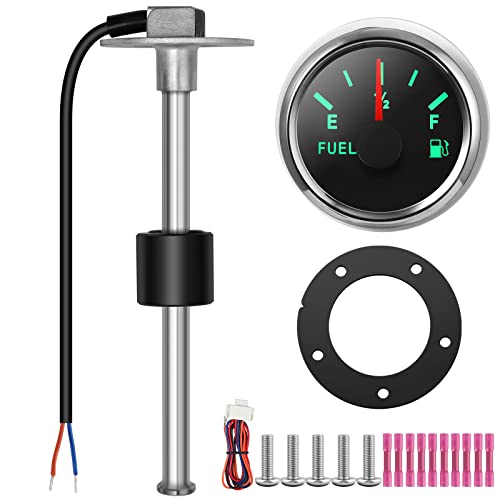
This stainless steel sender features an 8-color backlit gauge with IP67 waterproofing and anti-fog curved glass. It uses a 6.8-inch sensor length and SAE 5-hole mounting, with M5 screws and quick wiring terminals for straightforward installation. It’s best for mid-to-large tanks on boats or RVs where both durability and readability in low-light conditions matter. A limitation is that the installation depth must be compatible with the 6.8″ sensor length to maintain accurate readings.
Rupse Fuel Sender Unit Boat Fuel Tank Sending Unit 6″

The Rupse 6″ sender is built for durability with stainless steel construction and a corrosion-resistant interior. It supports common gauge signals and is designed for simplicity with 5-hole mounting and quick wiring terminations. Best for tanks that require a compact, robust sender with dependable long-term performance. A caution: verify the tank depth and mounting pattern match the 6″ rod length to ensure full-scale accuracy.
Buying Guide: Key Purchase Considerations
- Tank compatibility: Confirm sender length and gauge diameter (usually 52 mm/2-1/16″) to fit your tank opening.
- Electrical system: Verify operating voltage (commonly 12V–24V) and matching resistance (Ω) ranges (e.g., 240-33Ω, 0-190Ω) for accurate readings with your sender.
- Installation environment: Look for IP ratings (waterproof/dustproof) and corrosion resistance for saltwater use.
- Gauge features: Consider backlighting, readability, and whether the kit includes a complete sender and gauge assembly.
- Durability and materials: Stainless steel housings and anti-vibration needles improve longevity in rough seas.
- Ease of calibration: Some models require straightforward calibration to E-F (empty-full) with included instructions.
Frequently Asked Questions
- What is the typical impedance range for marine fuel gauges?
– Most marine gauges work with 240-33 ohms or 0-190 ohms, with several options supported by the included sender units. - Can I install a standard automotive gauge on a boat?
– Yes, if the gauge and sender share compatible voltage and resistance ranges and the installation fits the 52 mm diameter opening. - Do I need a professional for installation?
– Simple senders and gauges may be DIY-friendly; however, ensure correct wiring, waterproof seals, and mounting to prevent leaks or inaccurate readings. - Is backlighting important for night operation?
– Yes. Backlit gauges improve readability in low-light conditions and enhance safety while docking or navigating at night. - How do I know which sender length to choose?
– Measure tank depth and available clearance. Choose the sender length that reaches near the bottom of the tank without hitting the bottom.