You’ll want a marine epoxy primer that creates a strong, lasting bond, resists water exposure, and accepts topcoats reliably. This guide highlights select primers designed for fiberglass, wood, gelcoat, and basic metal surfaces above the waterline. Ideal for boat owners, professional refinishers, and DIY sailors, these choices balance build, durability, and ease of use. Below, each product is explained with who it’s best for, why it’s a strong pick, and practical considerations.
Buying guide at a glance: the table lists key product highlights to help you compare quickly.
| Product | Best For | Surface | Notes |
|---|---|---|---|
| TotalBoat Marine Topside Primer – White | Fiberglass and wood topsides | Fiberglass, wood, gelcoat | One-part, quick build; chromate-free |
| TotalBoat Marine Topside Primer – Gray | Higher build where needed | Fiberglass, wood, gelcoat | One-part, flexible undercoat |
| SAMURAI 2-Part Epoxy Primer – Grey | Critical bonding projects | Marine surfacers and topside prep | Two-component aerosol system |
| SAMURAI 2-Part Epoxy Primer – White | Light-colored topcoats | Marine surfacers and topside prep | Two-component aerosol system |
| Rust-Oleum Marine Metal Primer – White | Metal surfaces above waterline | Metal | Base coat for better adhesion |
TotalBoat Marine Topside Boat Paint Primer for Fiberglass and Wood, White
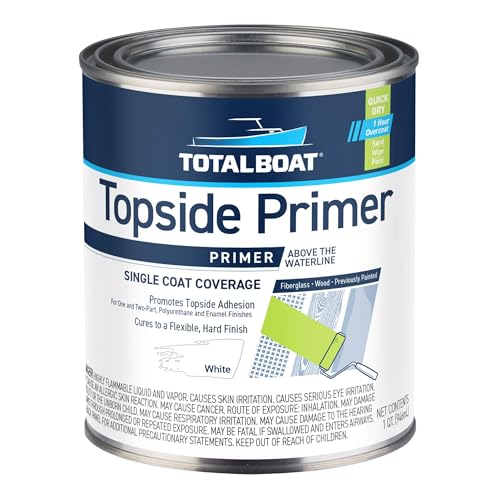
This one-part marine primer provides a durable, flexible undercoat for both 1-part and 2-part polyurethane and enamel topside paints. It’s approved for above-waterline use on fiberglass, wood, gelcoat, and surfaces in good condition that have been previously painted. A single thin coat can seal the surface, with a second coat if higher build is needed. Choose this if you want a simple, fast undercoat for standard topside finishes on smooth or lightly imperfect surfaces. Best for DIY boaters seeking straightforward application by brush, roller, or spray.
- Best for: quick, easy prep on fiberglass or wood hulls before topside color.
- Better for: achieving a smooth, flexible base with minimal coats.
- Caution: for large surface imperfections, fair with TotalBoat epoxy filler first.
TotalBoat Marine Topside Boat Paint Primer for Fiberglass and Wood (Gray, Quart)

This gray variant serves as a flexible, durable undercoat for topside paints, offering the same one-coat sealing capability as the white version. It’s well-suited when you anticipate a higher build or want a neutral base for light or mid-toned topcoats. It remains compatible with both 1-part and 2-part polyurethane and enamel systems. This option is ideal when you expect a slightly different shade underneath the final topcoat.
- Best for: builders who want a neutral gray base to tailor shade outcomes with topcoats.
- Better for: surfaces that require a consistent, flexible undercoat with minimal layering.
- Caution: ensure the surface is in good condition to avoid hiding major flaws under a single coat.
TotalBoat Marine Topside Boat Paint Primer for Fiberglass and Wood (White)

The third listing mirrors the white option with identical performance characteristics: one-part primer, straightforward application, and a single-coat seal that can be built up if needed. It is best for owners who want a bright, clean base for white or light topcoats or for a quick job where color brightness matters. Use where maximum adhesion and flexibility are required under lighter colors.
- Best for: bright topcoats or light color schemes on boats with light hulls.
- Better for: quick re-prime where surface is in good condition and above-waterline use is planned.
- Caution: avoid applying on heavily oxidized or severely etched surfaces without proper prep.
SAMURAI 2-Part Spray Paint Epoxy Primer for Marine Surfacer (Primer Grey, Pack of 1 Can)

This product uses a two-component system within a single aerosol can, blending hardener and paint for a convenient epoxy primer experience. It offers strong chemical resistance and bonding designed to help prevent rust and corrosion. Best for projects that require robust adhesion and quick turnarounds without external mixing equipment. It’s a good pick when you want the performance of an epoxy primer in a ready-to-spray format.
- Best for: quick epoxy priming without separate mix steps.
- Better for: areas with exposure risk where strong film formation is needed.
- Caution: aerosol systems may require careful ventilation and proper PPE during application.
SAMURAI 2-Part Spray Paint Epoxy Primer for Marine Surfacer (Primer White)
This white epoxy primer shares the same dual-component aerosol concept, delivering strong bonding and chemical resistance. It suits projects that require a bright base under light or white topcoats. The white color aids inspection for surface flaws before finishing. It’s chosen when long-term durability and resistance to marine elements are priorities in the repair or restoration workflow.
- Best for: white-topcoat projects where visibility of surface details matters.
- Better for: environments needing superior corrosion resistance on prepared surfaces.
- Caution: verify compatibility with the intended topcoat system to avoid color or film issues.
SAMURAI 2-Part Spray Paint Epoxy Primer for Marine Surfacer (Primer White, Pack of 1 Can)

This white epoxy primer pack offers the same two-part efficiency in a single can with no separate mixing required. It is well-suited for marine environments where corrosion resistance and reliable adhesion are essential. Use this if you want an easy-to-use, high-performance epoxy primer that simplifies inventory and application steps.
- Best for: streamlined epoxy priming with strong film formation.
- Better for: projects in coastal or humid settings needing robust protection.
- Caution: ensure the area is well-ventilated and follow the spray guidelines for best results.
Rust-Oleum 396963 Marine Metal Primer, Quart, White

This metal primer is designed for surfaces above the waterline, specifically to improve adhesion of subsequent topcoats on metal hull components or hardware. It serves as a base coat that protects metal from moisture-related adhesion issues and corrosion. Best for metal surfaces or mixed-material areas where you want a reliable foundation before enamel or polyurethane topcoats.
- Best for: prime-on-metal scenarios or parts exposed to sea spray and humidity.
- Better for: providing a stable base that enhances metal-to-topcoat bonding.
- Caution: not a substitute for epoxy-specific primers on fiber surfaces; use as appropriate for metal-only areas.
Buying Guide: Key Considerations for Marine Epoxy Primer Paint
Surface type and location strongly influence primer choice. Epoxy primers generally provide stronger adhesion and moisture resistance, especially on previously painted decks or fiberglass and wood. Consider the following:
- Surface compatibility: fiberglass, wood, gelcoat, or metal require different primer chemistries and adhesion strategies.
- One-part vs. two-part: one-part primers are easier and faster; two-part epoxy primers offer superior bond and chemical resistance for demanding environments.
- Topcoat compatibility: verify that the primer is designed to accept your chosen polyurethane or enamel topside paint.
- Application method: brushes, rollers, and spray options affect film build and overspray control; aerosol two-part systems simplify mixing but require ventilation.
- Prepping: for best results, prepare the surface by cleaning, removing corrosion, and feathering edges; fill large imperfections as needed.
- Safety and environment: work in a well-ventilated area; follow PPE guidelines and local regulations for solvent-based products.
Frequently Asked Questions
- Which marine epoxy primer is easiest to use for a DIY boat project? The one-part primers are typically easiest for DIYers, offering straightforward brushing, rolling, or light spray application.
- Do epoxy primers require a topcoat soon after application? Yes. Epoxy primers are designed to be covered with compatible topcoats to seal the film and protect against moisture and UV.
- Can I use a metal primer on a fiberglass hull? No, metal primers are intended for metal surfaces. Use a fiberglass-compatible epoxy or topside primer for hulls.
- Which primer works best for high-build needs? Two-part epoxy primers generally offer stronger adhesion and thicker build; they’re preferable when surface irregularities exist or in harsher environments.
- Should I use chromate-free primers? Many manufacturers offer chromate-free formulations for safer handling and environmental concerns; check product specs to confirm.
- Is sanding required between coats? In most cases, light sanding or scuffing between coats improves adhesion and final finish; follow the product’s directions for recoat windows.