Answering your search for reliable inspection ports for boats, this guide highlights top choices for marine access hatches. Ideal for boaters, yacht crews, RVers, and maritime hobbyists, these ports provide secure, weather-resistant openings for ventilation, inspection, or maintenance. The best picks balance durability, ease of installation, and a non-slip surface for safety. Below, you’ll find five models with clear on-product benefits and practical cautions to help you choose quickly.
Summary table of selected products:
| Product | Best For | Opening Size | Material | |
|---|---|---|---|---|
| Smart Marine 4 Inch Hatch (Single) | Small boats and interior compartments | 4 in | ABS | Detachable cover option |
| Smartmarine 4″6″8″ White Hatch (4 in) | Yachts and larger boats | 4 in | ABS | ULTRA weather resistance |
| JZLiner 5 Inch Hatch White | Medium openings for kayaks and RVs | 5 in | ABS | Pre-drilled holes, easy install |
| JZLiner 5 Inch Hatch Black | Dark deck aesthetics, durable access | 5 in | ABS | Rotating close/open mechanism |
| CROSSBODY 2 Pcs 4″ Deck Plates | Budget-friendly twin-port setups | 4 in | ABS | Includes screws |
Smart Marine 4 Inch Boat Hatch Cover (Single)

- High Quality: Solid ABS material with weather-tight and O-ring sealed deck plates. Anti-corrosive and UV resistant.
- Apply To: Suitable for all kinds of boats and yachts. Ideal for interior and exterior applications.
- Features: Smooth surface, reinforced design with a non-slip surface; 180° opening hatch; available in 4/6/8 inch deck plates.
Best for: boaters seeking a compact, durable hatch for tight spaces on small to mid-size vessels. The detachable cover adds security and flexibility for maintenance access. Limitation: smaller footprint may limit larger access tasks.
Smartmarine White Hatch 4″6″8″ Round (4 in)
- High Quality: ABS deck plates with weather-tight sealing, anti-corrosive and UV resistant.
- Apply To: Suitable for boats and yachts, interior and exterior use.
- Features: Non-slip surface, reinforced design, 180° opening; available in 4/6/8 inch deck plates.
Best for: owners wanting a versatile hatch that fits multiple drill sizes and rig configurations. Better for: installations needing a larger 6–8 inch option in the same family. Caution: ensure proper O-ring seating for full weatherproof seal.
JZLiner 5 Inch Inspection Port White
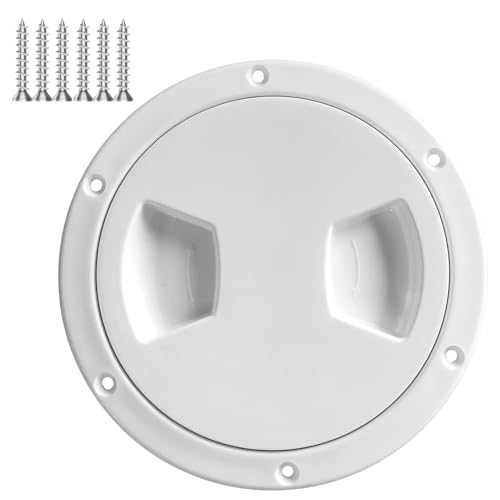
- Deck Plate Size: Opening diameter 5.5 inches; outside diameter 6 3/4 inches; pre-drilled holes with screws included.
- Features: Durable ABS, non-slip surface; easy rotation for close/open.
- Best For: medium openings on kayaks, boats, and RVs where a little extra clearance is desired.
Best for: customers needing a 5-inch deck opening with straightforward installation. Choose this if you want a simple, TURN-KEY mounting with included screws. Limitation: outer dimensions may require slightly larger cutouts on older decks.
JZLiner 5 Inch Hatch Black

- Deck Plate Size: 5.5 inch opening diameter with 6 3/4 inch outside diameter; includes screws.
- Materials: Durable ABS plastic; non-slip surface and solid construction.
- Best For: aesthetically versatile option for darker deck colors or when black hardware is preferred.
Best for: matching dark deck aesthetics while maintaining a reliable inspection port. Better for: installations requiring a cohesive black finish. Caution: verify screw count and hole spacing to fit your hull plates.
CROSSBODY 2 Pcs 4″ Deck Plates

- Two-Pack: 4″ black round deck plates with a water-tight seal and screws included.
- Material: ABS plastic, UV resistant and designed for long life on boats and kayaks.
- Best For: budget-conscious builds and twin-port configurations. Limitation: only 4 inch size available in this set.
Best for: users needing a cost-effective, twin-port solution with straightforward installation. Choose this if you want extra decks or a spare hatch for future projects. Avoid this if you require larger 6–8 inch openings in the same line.
Buying Guide: How to Choose the Right Boat Inspection Port
What opening size do you need? Measure the existing deck cutout or desired access. Common sizes are 4, 5, and 6 inches for boats and RVs, with larger plates offering easier access but requiring bigger cutouts.
What material matters? ABS plastic is standard for marine hatch faces due to weather resistance and durability. Look for UV protection and a tight O-ring seal to prevent water intrusion.
Is the hatch interior suitable for your use? Consider interior vs. exterior placement. A non-slip surface reduces slip risk on wet decks. A detachable cover can add security and simplify maintenance tasks.
How many units do you need? Twin-port sets may save installation time and give redundancy, but single hatches are often enough for compact boats.
What installation considerations apply? Check pre-drilled hole patterns and screw counts. Universal screw sets simplify mounting, but you may need longer fasteners for thicker decks.
What should you avoid? Avoid low-quality seals, insufficient UV resistance, or hatches without a robust locking mechanism when exposed to harsh marine environments.
FAQ
- What is the most common deck plate size for small boats?
4 inches is the most common compact size for small boats and interior compartments. - Do these hatches require special tools to install?
Most include pre-drilled holes and screws; basic drill or screwdriver is typically enough. - Are ABS hatches safe for outdoor marine use?
Yes, ABS is standard for outdoor marine use when UV resistant and weather-tight seals are included. - Should I choose a 4-inch or 5-inch hatch for a kayak?
A 5-inch hatch provides easier access and more room for hand movement in kayaks, but will require a larger cutout. - Can I install these hatches horizontally or vertically?
Many designs support both orientations, offering flexibility for deck layout and access direction.