Discover the best fuse block options for boats to protect 12V/24V systems. Each selection is suitable for marine applications, with clear indicators, organization features, and durable construction. This guide targets boaters, RV owners, and marine enthusiasts who want reliable circuit protection and neat wiring. Below is a quick buyer’s table for the five recommended products, highlighting key attributes and ideal use cases.
| Product | ||||
|---|---|---|---|---|
| Cyrico 12-Circuit Fuse Block | 12 | 100 A (30 A per circuit) | Mid-size marine electrical panels | |
| Blue Sea Systems ST Blade 12 Circuit | 12 | 100 A (up to 30 A per circuit) | High-demand DC systems | |
| Tigwin 12V Fuse Box 6 Way | 6 | Not specified per circuit | Compact setups with basic needs | |
| FASTSTORM 12 Way Fuse Block | 12 | Not specified per circuit | All-in-one ready-to-install | |
| DAIERTEK 12 Way Fuse Block | 12 | 30 A per way, 100 A panel | Marine and automotive 12V/24V systems |
Fuse Block, 12V 12-Circuit Panel With LED Indicator

The Cyrico 12-Circuit Fuse Block provides a compact 12-slot layout with a grounding bus, ideal for boats needing multiple protected circuits. It uses nickel-plated copper for busbars and fuse clips, delivering strong conductivity and corrosion resistance. The PC cover offers dust and splash protection to extend lifespan. Best for: mid-size marine electrical systems with several independent devices.
- Best for organized 12-circuit protection on boats and RVs.
- Clear LED indicator shows which fuse blows for quick maintenance.
- Includes labeling stickers to simplify circuit identification.
Caution: Ensure your total load stays within the 100-amp panel rating and check fuse ratings per circuit to avoid overcurrent conditions.
Blue Sea Systems ST Blade Fuse Block 12 Circuit

This 12-circuit fuse block includes a grounded negative bus and a clear insulating cover with a secure latch. It supports up to 100 amps total capacity and up to 30 amps per circuit with standard ATO/ATC fuses. Best for: higher-demand DC systems requiring robust ground integration and easy circuit labeling.
- Best for vessels needing a dedicated ground path per block.
- Integrated spare fuse storage helps rapid maintenance.
- Protects multiple circuits with clear circuit identification.
Limitation: This unit assumes standard blade fuses; verify compatibility with the fuse types you plan to use.
Tigwin 12V Fuse Box 6 Way With LED Indicator
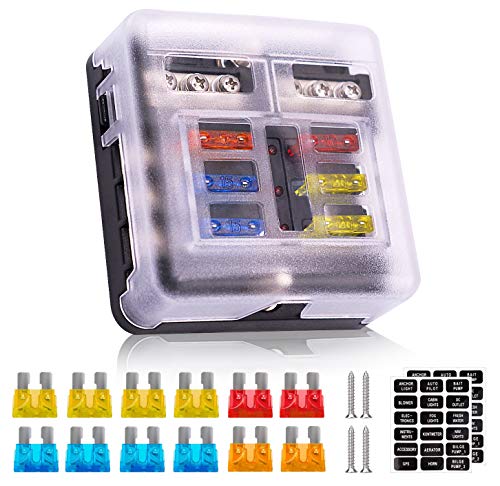
The Tigwin 6-way fuse block uses fire-resistive PBT material with high mechanical strength and good insulation. It features a red LED indicator that lights when a fuse blows and 12 fuse positions with a ground bus to keep wiring tidy. Best for: smaller boats or vehicles needing compact protection with easy fault signaling.
- Best for space-constrained installations.
- LED indicator aids quick troubleshooting.
Caution: Per-circuit capacity is not stated; confirm the expected load per circuit for marine use cases.
FASTSTORM 12 Way Fuse Block With LED

The FASTSTORM kit combines a 12-way fuse block with a full fuse set (30A, 25A, 20A, 15A, 10A, 5A). It includes heat shrink terminals and a protective cover with IP53-level waterproofing. Best for: boaters who want a ready-to-install, complete solution with built-in labeling and fuses.
- Best for quick deployment and fewer accessory purchases.
- Waterproof cover reduces exposure to marine environments.
Limitation: Some users may need additional fuse types not included; plan for potential extra components.
DaierTek 12 Way Fuse Block With LED

The DaierTek 12-way panel provides 12 jacks and 12 wiring locations with a red LED indicator for blown fuses. It has a max 32V DC operating range and supports up to 30A per circuit, 100A per panel. Best for: marine electrical builds needing clear fault signaling and robust protection across multiple circuits.
- Best for boats requiring multiple fused circuits with quick fault visibility.
- Protects devices with a high-voltage tolerance within 32V DC.
Caution: Ensure your total current does not exceed the panel’s 100 A limit, and confirm fuse compatibility with your devices.
Buying Guide: Choosing The Right Boat Fuse Block
What makes a fuse block marine-ready?
Look for waterproof or splash-protected housings, corrosion-resistant busbars, and a design that minimizes moisture ingress. A grounded negative bus and clear labeling help long-term maintenance on boats.
How to size and wire correctly?
Match per-circuit fuses to device current needs while respecting total panel capacity. Use a separate fuse for each circuit and ensure wiring gauge is appropriate for the current and distance.
What about indicators and labeling?
LED indicators simplify fault finding at sea. Labeling stickers or recessed label areas help you quickly identify circuits during routine inspections or emergency troubleshooting.
Should you choose a complete kit or individual parts?
Complete kits save time and ensure compatibility, especially for beginners. For advanced configurations, a modular block with a separate fuse assortment may offer more flexibility.
Common caveats to watch for
Check per-circuit amperage ratings, total panel capacity, and compatibility with your fuse type (ATO vs. ATC). Ensure the panel fits your installation space and mounting requirements.
FAQ
- What is a fuse block and why do boats use them?
A fuse block distributes electrical power to individual circuits while protecting wires and devices from overloads in a marine setting.
- How many circuits do typical marine fuse blocks support?
Blocks range from 6 to 12 circuits, with some models offering 12, 6, or more depending on the design.
- What maintenance is required for fuse blocks on boats?
Check fuses regularly, replace blown fuses promptly, and inspect wiring for corrosion or loose connections after exposure to saltwater.
- Is an LED indicator necessary?
LED indicators speed fault identification by highlighting blown fuses, which is especially valuable in low-light marine environments.
- How do I choose between a 12-way and a 6-way fuse block?
Choose based on the number of circuits and required space. A 12-way fits more devices but requires more accurate wiring and planning.
- What should I consider for per-circuit amperage?
Per-circuit amps should match device current draws; exceeding a circuit’s rating can cause overheating and damage.