Finding an affordable kayak fish finder that still delivers reliable depth, fish hints, and bottom structure is a smart move for budget-conscious anglers. This guide highlights five value-packed options and explains who each is best for. You’ll learn which model fits a kayak, what trade-offs come with low-cost sonar, and how to choose the right display, beam angle, and transducer setup for moving water. The top picks are suited for casual kayak fishing, weekend warriors, and beginners who want straightforward depth and fish location data without breaking the bank.
Summary table of selected products
| Product | Best For | Key Benefit |
|---|---|---|
| Yoocylii Handheld Fish Finder | Compact kayakers and beginners | Lightweight, portable, suitable for moving water under 5 mph |
| Humminbird PiranhaMAX 4 | Structured detail seekers | Dual beam sonar for detailed or wide-area views |
| LUCKY MT-202 Wireless | Wireless ease, larger water bodies | Long-range wireless operation |
| Venterior Portable Wireless | Cast-and-go simplicity | Color display, depth and temperature |
| WINDFRD Mount System | Customizable setups | Flexible mounting for separate displays and transducers |
Yoocylii Handheld Fish Finder

What it is best for: budget-conscious kayakers who want a compact, portable unit they can wear or stash in a tackle box. It’s well suited for freshwater and saltwater use, and for anglers who fish from a kayak, dock, or ice. The device reads depth, approximate fish location, and bottom features, including weeds, sand, and rocks.
Why it’s selected: this handheld model prioritizes portability and ease of use. It includes a neck strap for hands-free carrying and runs on standard AAA batteries, delivering several hours of operation. Deep-water performance is adequate for shallow to mid-range kayak fishing.
Limitations: its depth range and display are basic compared with higher-priced setups. It’s best used by casual anglers who value portability over ultra-detailed sonar mapping.
Best-for quick check-ins on small water bodies, or for beginners who want a simple, no-fruss setup while paddling.
Humminbird PiranhaMAX 4 Fish Finder

What it is best for: anglers who want clearer target details and flexible viewing options. The dual-beam sonar helps balance detail with a wider coverage area, making it suitable for identifying fish around structure and contours.
Why it’s selected: the dual-beam approach gives more granular detail when you need it, and the tilt/swivel mounting provides adjustable viewing angles. It’s a reliable option for kayak fishermen who want dependable sonar without going into high-end setups.
Caution: this model lacks some advanced features found on top-tier devices, so expect simpler data presentation and fewer modes. It’s a straightforward tool for standard shallow-water fish finding.
Choose this if you want detailed sonar at a reasonable price and flexible mounting options on your kayak or small boat.
LUCKY Kayak Portable Fish Finder MT-202

What it is best for: paddlers who want a compact, handheld unit with a rechargeable option and a 3.5-inch display. It’s suitable for salty or freshwater and can help track depth, fish depth, and bottom contours.
Why it’s selected: this model emphasizes portability and ease of use, with a long measurement range and a readable LCD, plus a backlit display for sunny or dim conditions. It’s practical for casual kayak trips and short excursions.
Caution: some users may prefer larger screens for complex structure hunting. Battery life is adequate but not exceptional in extended trips.
Choose this if you want a compact, rechargeable unit with a simple interface and a clear display for mid-range fishing.
LUCKY Wireless Kayak Depth Finder MT-202
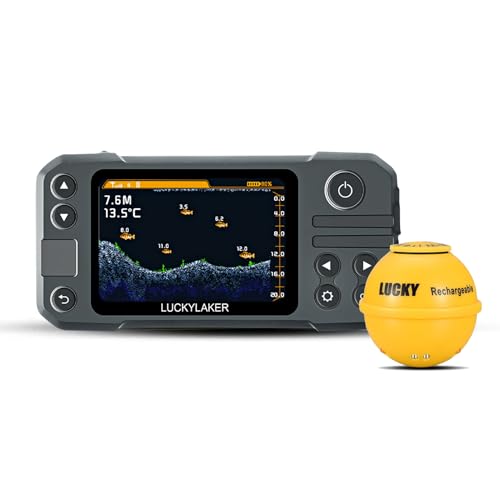
What it is best for: kayak anglers who want no-wires operation and a long-range transducer connection. Wireless capability supports flexible mounting and quick setup on moving water.
Why it’s selected: the long wireless range and 90-degree beam help you scan water for fish schools and bottom structure without cluttering deck space. The 3.5-inch display provides a straightforward readout of depth and fish location.
Caution: wireless systems can be sensitive to interference or range limits in certain settings. Ensure proper pairing and maintain line-of-sight for best results.
Choose this if you value a wire-free solution and easy repositioning on a kayak or boat.
WINDFRD Kayak Fish Finder Mount System

What it is best for: anglers who want a clean, adaptable mounting solution for both display screens and transducers. It’s ideal for yak enthusiasts who use multiple brands and need a single mount point.
Why it’s selected: this mount system integrates a transducer arm and display mounting, reducing clutter and improving adjustability. It works with common brands and can slide along a track for quick repositioning.
Caution: this is a mounting accessory, not a fish finder itself. Ensure compatibility with your existing display and transducer before purchase.
Choose this if you need a flexible, durable mounting solution to unify your kayak electronics setup.
Buying Guide: How to Choose a Cheap Kayak Fish Finder
What should you consider when shopping on a budget? Start with purpose and water type. If you fish mainly in calm lakes or slow rivers, a simple handheld or castable unit often suffices. For moving kayaks or choppier seas, a paddle-friendly or wireless setup reduces deck clutter and improves usability.
- Display size and clarity: A larger screen improves readability in bright sun and helps you quickly identify targets. For small boats, a 3.5-inch or 4.3-inch screen is common and practical.
- Beam angle and depth range: A wider beam (around 90 degrees) covers more water but may reduce detail. Dual-beam or adjustable-beam models offer a balance between detection area and target clarity.
- Transducer mounting: Surface-mounted or hull-mounted transducers require appropriate mounting gear. A flexible rail or track mount can simplify on-the-water adjustments.
- Power and battery: Handheld units use replaceable AAA or rechargeable batteries; castable and wireless models have built-in rechargeable packs. Plan for the length of your trips.
- Water type and salt exposure: If you fish saltwater, ensure corrosion resistance and proper sealing. Marine-grade materials extend life in salt spray.
- Ease of use: Simpler interfaces help quick reads, especially for beginners. Look for backlit displays and intuitive icons for depth, fish size, and bottom features.
- Portability vs. depth data: Handheld devices trade advanced depth mapping for portability. If detailed structure mapping matters, choose a model with broader data presentation.
Frequently Asked Questions
- What is the best budget kayak fish finder for beginners?
– A handheld or castable unit with simple depth and fish indicators is typically best for beginners, offering quick results without complexity. - Do wireless kayak fish finders work well on moving boats?
– Yes, many wireless models are designed for moving water; ensure the transducer is properly oriented and within the specified range for reliable readings. - How important is beam angle when choosing a fish finder?
– Beam angle affects coverage: a wider beam covers more water, while a narrower beam provides more detail at depth. A model with adjustable beam can be advantageous. - Can I use a standard marine fish finder on a kayak?
– Some models are designed for small boats and can be adapted to kayaks with mounting solutions. Verify compatibility with your track system and space. - Is a color display necessary?
– Color displays improve readability in bright light and can help differentiate depth, fish, and structure more clearly. - What maintenance is required for a cheap fish finder?
– Keep connectors dry, rinse after saltwater use, and check mounting hardware for corrosion or looseness.