Answering the common question “which battery powered paddle board pump is best for me,” this guide highlights five top models that balance speed, battery life, and portability. Ideal buyers range from casual weekend paddlers to group trip organizers and instructors who need reliable, cordless inflation on the water. Below, you’ll find concise product overviews, clear buyer cues, and a practical buying guide to help you compare performance and pick the right pump for your needs.
| Product | Battery / Power | Max PSI | Best For |
|---|---|---|---|
| OGERY Paddle Board Electric Pump | Removable battery; USB/Type-C ports | 12–15 PSI | Large groups, full-day sessions |
| S8 Electric Paddle Board Pump | 59.2Wh battery; cordless | 12–15 PSI | Travel light, quick full inflations |
| GICLE 22PSI Electric SUP Pump | 59.2Wh built-in battery; 12V car option | 12 PSI (auto-off at target) | Long outdoor sessions; car use |
| AIRSURE 20PSI High Pressure Pump | Rechargeable battery; DC car connector | 20 PSI | High-pressure needs; instructors |
| Peakspeak 20 PSI Electric Pump | 4×2600mAh battery | 12–15 PSI | Digital control and compact carrying |
OGERY Paddle Board Electric Pump

This pump offers a detachable battery and dual-stage inflation, designed for inflating up to 4.5 standard SUP boards at 12 PSI or 4 boards at 15 PSI per charge. The removable battery doubles as a power bank with USB and Type-C ports, delivering up to 65W for mobile devices. It inflates a standard SUP to 12 PSI in about seven minutes, then automatically shifts to high-pressure mode for efficient topping off. Best for family trips or group outings where multiple boards may be in use.
Who it’s best for: buyers planning multi-board days without frequent recharging. Why selected: high-capacity battery, multiple device charging, and efficient dual-stage inflation reduce downtime between setups.
Caution: ensure the battery is fully charged before long excursions; heavier use may still require extra battery swaps.
S8 Electric Paddle Board Pump
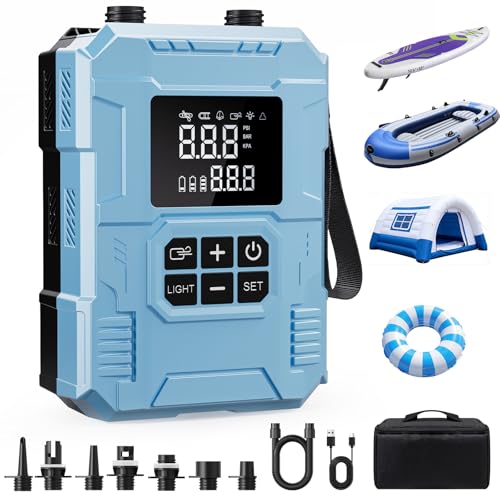
Powered by a dual-motor system, the S8 delivers up to 35% faster inflation and inflates a 10.6 ft paddle board to 12 PSI in under five minutes. It uses a 59.2Wh battery and includes a built-in deflation feature for easy packing. The pump is compact at about 3.2 pounds and comes with a storage bag, making it well suited for travel. Best for: paddlers who prioritize speed and portable design on frequent outings.
Best for: faster, more dependable inflations on the go. Limitation: while compact, battery life is optimized for multiple inflations rather than very long sessions without recharging.
Uiophom 50PSI Paddle Board Pump

This model pushes up to 50 PSI, enabling use across an array of inflatables beyond paddle boards, including tires and tents. It uses a 6×2600mAh battery with 18W fast charging and includes a 12V DC car connector for on-the-road power. It can inflate a 10.6 ft SUP to 12 PSI five times on a single charge. Best for: group outings where multiple inflatables are used or when car power is convenient.
Choose this if: high-pressure capability and versatility across gear are priorities. Caution: larger batteries add weight; consider transport needs.
kosmegal Electric Paddle Board Pump

With a high-pressure capability and a dual-action design, kosmegal inflates a 10.5 ft SUP to 12 PSI in under seven minutes and deflates quickly. A built-in 6×2000mAh battery and Type-C charging support extended use, while 11 included nozzles broaden compatibility to tents and kayaks. Best for: users who value accurate inflation and fast deflation in varied outdoor gear. Caution: consider cooling requirements during extended sessions to prevent overheating.
GICLE 22PSI Electric SUP Pump

GICLE offers a true dual-power setup with a 59.2Wh battery and a 12V car option, enabling over 20 boards on continuous use. It features a 0.01 PSI LCD precision and auto-off at the target pressure, plus a fast inflation rate. Best for: those who require precise pressure control and automotive versatility. Caution: rely on the LCD display for accurate readings in bright sunlight or glare conditions.
Buying Guide: Key Purchase Considerations
- Battery life vs. board count: If you regularly inflate multiple boards, prefer pumps with larger battery packs or removable batteries. Consider how many boards you’ll inflate in one session.
- Max pressure and inflation speed: For performance-focused users, choose models that reach 12–15 PSI quickly and offer true dual-stage inflation with auto-off features.
- Portability and durability: Lightweight units with compact form factors are ideal for travel. Look for pumps with carrying bags or integrated handles for convenience.
- Power options: Pumps offering both built-in battery and car charger compatibility provide flexibility for on-road use and camping trips.
- Deflation capability: Quick deflation helps with packing, especially when on a tight schedule for multiple boards or tents and kayaks.
- Nozzle compatibility: A wide range of nozzles ensures compatibility with different paddle boards, tents, kayaks, and other inflatables.
Frequently Asked Questions
- Which paddle board pump is best for group trips?
– The OGERY and Peakspeak models offer strong battery capacity and multi-board inflation potential, reducing recharge downtime for groups. - Do these pumps support high-pressure needs?
– Yes, several pumps reach up to 20 PSI, with GICLE and AIRSURE offering high-pressure modes for stiffer boards and rigorous inflation. - Is auto-off at target pressure reliable?
– Most listed models include auto-off features that stop inflation when the set pressure is reached, protecting boards from over-inflation. - Can I use car power to inflate boards?
– Several models include 12V car adapters, making on-the-go inflation feasible at the beach or campsite. - Are these pumps suitable for items other than paddle boards?
– Yes, many come with multiple nozzles and support inflating tents, kayaks, air mattresses, boats, and more. - Which pump is the best overall value?
– The choice depends on your priorities—speed, battery life, and versatility—balanced by budget and transport needs.