Answering the demand for reliable, high-capacity marine charging, this guide highlights 50 amp chargers ideal for boats with multiple battery banks. It helps boaters choose devices that deliver fast, safe charging while protecting alternators and house batteries. The top picks suit dual-system roving crews, liveaboard mariners, and weekend boaters who need dependable shore- or engine-powered charging. The following summary table shows the selected options and their primary strengths.
| Product | Best For | Key Benefit |
|---|---|---|
| ProMariner ProNautic 1250P | Multi-bank boats | Advanced digital charging with on-demand distribution |
| Victron Orion XS 1400 | Compact, high-output DC-DC | 12/24 V versatility with high efficiency |
| Victron Centaur 50A 3 Bank | Global use, multiple banks | Auto-ranging input and temperature sensing |
| Victron Orion-XS Smart DC-DC | Smart dual batteries | Bluetooth monitoring, IP65 ruggedness |
| Sterling Power PCU1250 | Global compatibility | 11 charging curves and 3-bank multi-channel |
Note: Each product below targets 50 amp capacity with multi-bank configurations for marine use. The sections provide clear “best for” guidance, why the model was chosen, and a practical caution where relevant.
ProMariner ProNautic 1250P (12V, 3-Bank)

The ProNautic 1250P uses Generation 3 digital control with software-based power conversion to optimize multi-bank charging. It features distributed-on-demand technology that automatically senses and distributes available charging capacity across banks, and supports 12 selectable four-stage profiles for charging, conditioning, auto-maintain, and reconditioning. Best for boaters who need flexible, fully automatic multi-bank management and digital profile control. A potential limitation is that detailed bank-by-bank diagnostics may require the control interface to interpret the 12 profiles accurately in all conditions.
Victron Orion XS 1400 12/24V DC-DC

This DC-DC charger leverages engine alternators to charge the house battery with 98.5% efficiency. It handles 12 V, 24 V, or mixed systems, and is compatible with lithium, LiFePO4, lead-acid, AGM, and gel batteries. It’s ideal for compact setups where space and weight matter, providing consistent output even at high ambient temperatures. Best for: space-conscious boaters who need a robust, high-efficiency DC-DC solution. Caution: complex configurations may require the Victron app and proper settings for mixed battery chemistries.
Victron Centaur 12V 50A 3 Bank

Centaur 50A features auto-ranging 90-265VAC input and internal temperature sensing to reduce output when needed. It charges at a bulk rate until the current drops to 70% of rated amps, then uses a four-hour timer to shift toward float. Best for international use and boats with diverse shore power sources. Limitation: the 4-hour timer may require monitoring if you depend on precise float behavior for summer storage cycles.
Victron Orion-XS Smart DC-DC Charger

This smart DC-DC charger is designed for dual battery systems charged by intelligent alternators. It delivers up to 700W continuous output with 98.5% efficiency and features IP65 waterproofing. Best for: high-demand dual-battery setups where monitoring and configurability (via Bluetooth) add value. Caution: requires compatible control devices and app access to maximize features.
Sterling Power PCU1250 Marine Charger

The Pro Charge Ultra PCU1250 offers global 90-270V input compatibility and 11 pre-programmed charging curves, including LiPo4, GEL, AGM, and Flooded Lead Acid. It supports up to three battery banks simultaneously with 50A output. Best for: boaters who need broad voltage compatibility and multiple charging profiles in one unit. Caution: some environments may require additional training to select the appropriate charging curve for each battery bank.
Renogy 12V 50A MPPT DC-DC Charger
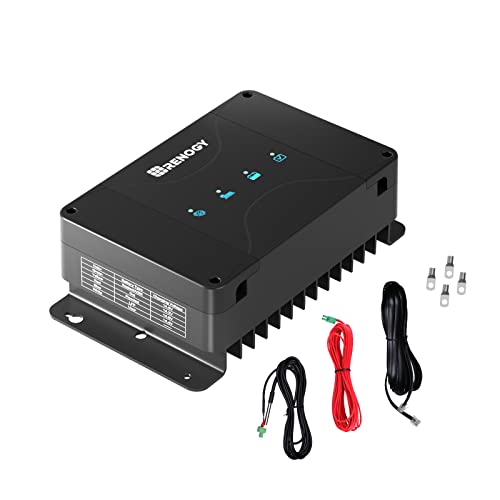
Renogy’s multi-input MPPT charger supports charging from both alternator and solar panels with up to 99% MPPT tracking efficiency. It handles 12V systems with the ability to charge house batteries from a linked starter battery or solar source. Best for: solar-plus-DC-DC setups that maximize charging time. Caution: MPPT efficiency depends on panel exposure and wiring; performance may vary with extreme shading or miswiring.
Buying Guide: Key Considerations
What to assess when choosing a 50A marine battery charger? Battery bank count, input voltage range, and charging profiles matter. Multi-bank units simplify wiring for boats with separate house and starter batteries. DC-DC chargers are ideal when charging from the engine’s alternator, reducing draw from the starting battery. Global input compatibility helps international travelers and boats visiting marinas worldwide. Efficiency and thermal management influence long-term reliability, especially in hot climates. IP ratings indicate water exposure tolerance, important for exposed installations.
How to Compare Between Models
- Charging performance: Look for four or five-stage charging with conditioning and reconditioning for lead-acid and AGM batteries, plus smart algorithms for LiFePO4.
- Bank configuration: Choose models that support two or more banks with clear distribution logic to avoid overloading any single bank.
- Monitoring and control: Bluetooth or app-based monitoring is a plus for remote oversight and settings adjustments.
- Durability: IP65 rating or better protects against spray and splash in marine environments.
FAQ
- What is a 50A marine battery charger best used for? It powers multiple battery banks on a boat, enabling fast replenishment of the house and starter batteries, especially on larger vessels.
- Do I need a separate solar MPPT charger if I buy a DC-DC charger? Not always; some models integrate MPPT or solar charging options, but solar-specific chargers can optimize sun charging independently.
- Is an IP65 rating important for marine chargers? Yes, it provides protection against dust and water exposure in typical boat environments.
- Can these chargers work with lithium batteries? Many do, but verify compatible chemistries and charging profiles for LiFePO4 or other lithium variants before use.
- What maintenance is required? Periodic inspections of wiring, fuses, and connections; ensure ventilation to prevent overheating during operation.