Looking for a reliable two-person kayak for whitewater and shared paddling adventures? This guide highlights five top models that balance stability, durability, and ease of use. Each option is suited for different paddler types—casual weekend rafters, family river explorers, or serious riverside trekkers—so you can pick the best fit for your trips. The table below compares key features to help you decide quickly.
| Product | Best For | Key Benefit |
|---|---|---|
| Intex Explorer K2 | Beginners, lakes and mild rivers | Lightweight, quick setup, high visibility |
| Aqua Marina STEAM 13’6″ | All-around river and class III | Optimized hull speed and tracking |
| Intex Excursion Pro K2 | Extended trips, gear lovers | Heavy-duty PVC, extra storage |
| Sea Eagle 420X QuikSail | Open water with wind sailing option | Downwind sailing capability |
| Goplus 11.5 ft 2-Person | Budget-friendly tandem touring | Three-chamber design, included paddles |
Intex Explorer K2 Inflatable Kayak
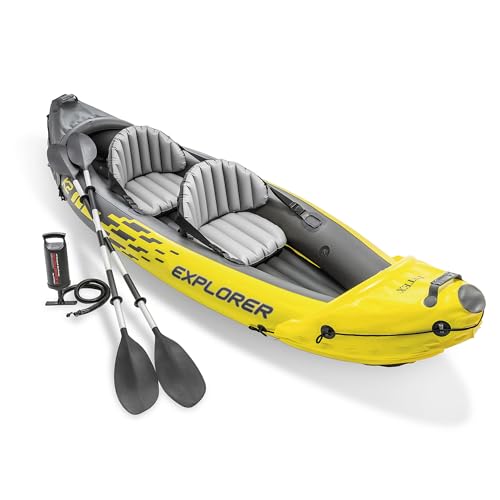
Best for beginners and casual river trips. The Intex Explorer K2 offers a lightweight, compact design with an easy Boston valve for quick inflation and deflation. The aluminum oars are detachable for simple transport, and a carrying bag helps you take it anywhere. Its bright yellow color enhances visibility, which is a safety advantage on busy waterways. The I-beam floor and high-buoyancy side chambers contribute to stability and comfort. A removable skeg improves tracking in varied water conditions.
Who it’s best for: new paddlers or families seeking a straightforward setup for lakes or mild rivers. Why selected: affordable, portable, and easy to maneuver for two. Caution: performance may be limited on fast or technical rapids due to its simpler hull design.
Aqua Marina STEAM 13’6″ 2-Person Inflatable Kayak

Best for versatile river and open-water use with improved hull speed. The STEAM features a streamlined outline designed to boost tracking and speed, making it suitable for more energetic excursions. High-frequency welded seams contribute to a strong bond, while V-cone protection on the stem and stern helps with collision resistance. It’s well-suited for paddlers who want a semi-rigid feel with better pace across water. A good choice for couples who enjoy longer river trips or lake crossings.
Who it’s best for: paddlers seeking enhanced speed and tracking in a two-person setup. Why selected: robust construction and river-capable performance. Caution: heavier use in fast currents may require extra caution and paddling technique for optimal control.
Intex Excursion Pro K2 Inflatable Kayak Set

Best for extended trips with more gear. The Excursion Pro K2 uses a heavy-duty 3-ply laminate PVC with SuperStrong formulation for improved rigidity and durability. It offers high-pressure inflation for stability and has spring-loaded valves for quick deflation. The two removable skegs enhance maneuverability in varied water depths. Extra storage space and stainless steel D-rings for gear securement support longer excursions and organized packing.
Who it’s best for: campers and river explorers who carry extra gear. Why selected: rugged construction and enhanced stability for longer outings. Caution: heavier setup and higher inflation pressure may require more time to prepare before launch.
Goplus Inflatable Kayak 2 Person

Best for budget-conscious buyers seeking a tandem touring option. This model uses reinforced heavy-duty PVC and supports up to 352 lbs, with 3 independent air chambers for safety. It includes two inflatable backrests and a footrest for comfort, plus the three-chamber design aims to balance stability with portability. The manual pump enables straightforward on-shore setup, making it accessible for casual river trips and lakes.
Who it’s best for: shoppers prioritizing affordability and basic tandem capability. Why selected: good value with essential comfort features. Caution: overall performance may be limited in rough water or demanding whitewater conditions.
Buying Guide: Key Considerations for Two-Person Whitewater Kayaks
- Intended use: Are you planning calm lakes, gentle rivers, or Class III-IV whitewater? Match hull design and stability to your typical conditions.
- Durability: Look for multi-layer PVC or reinforced materials, high-pressure drop-stitch floors, and robust seams for longevity on rugged water.
- Stability vs. speed: Wider boats offer more stability; narrower hulls track straighter and move faster. Consider your balance and paddling style.
- Inflation and setup: Check valve types, number of tubes or chambers, and whether the model includes a pump and paddles. Quick setup matters for families and casual users.
- Gear storage: If extended trips are planned, prioritize extra bow/stern storage, D-rings for securing bags, and removable skegs for maneuverability.
- Portability: Weighs and packed size affect transport. Consider a carrying bag and ease of deflation for travel.
- Visibility: Bright colors and reflective features improve safety on busy waterways.
- Seats and comfort: Removable or adjustable seats with backrests improve comfort on longer paddles.
FAQ
- What’s the difference between a two-person kayak and a solo kayak? Two-person models are designed to accommodate two adults with shared weight and paddling effort, offering teamwork on longer trips.
- Are inflatable kayaks suitable for whitewater? Some models are rated for mild to moderate whitewater, especially those with rugged construction and stronger seams. Always review the manufacturer’s water condition guidance.
- Do these kayaks require a pump? Most sets include a manual pump or a pump-friendly valve system, but confirm based on the specific model you choose.
- How much weight can a typical two-person inflatable kayak hold? Capacity varies by model, commonly between 350–500 pounds total for most tandem inflatables.
- How easy is it to transport inflatable kayaks? They compress into compact sizes and usually come with carrying bags, making them portable for car trips and storage.
- Should I choose a kayak with removable skegs? Removable skegs improve tracking in shallow or calm water, but may add setup steps. Consider where you paddle most often.